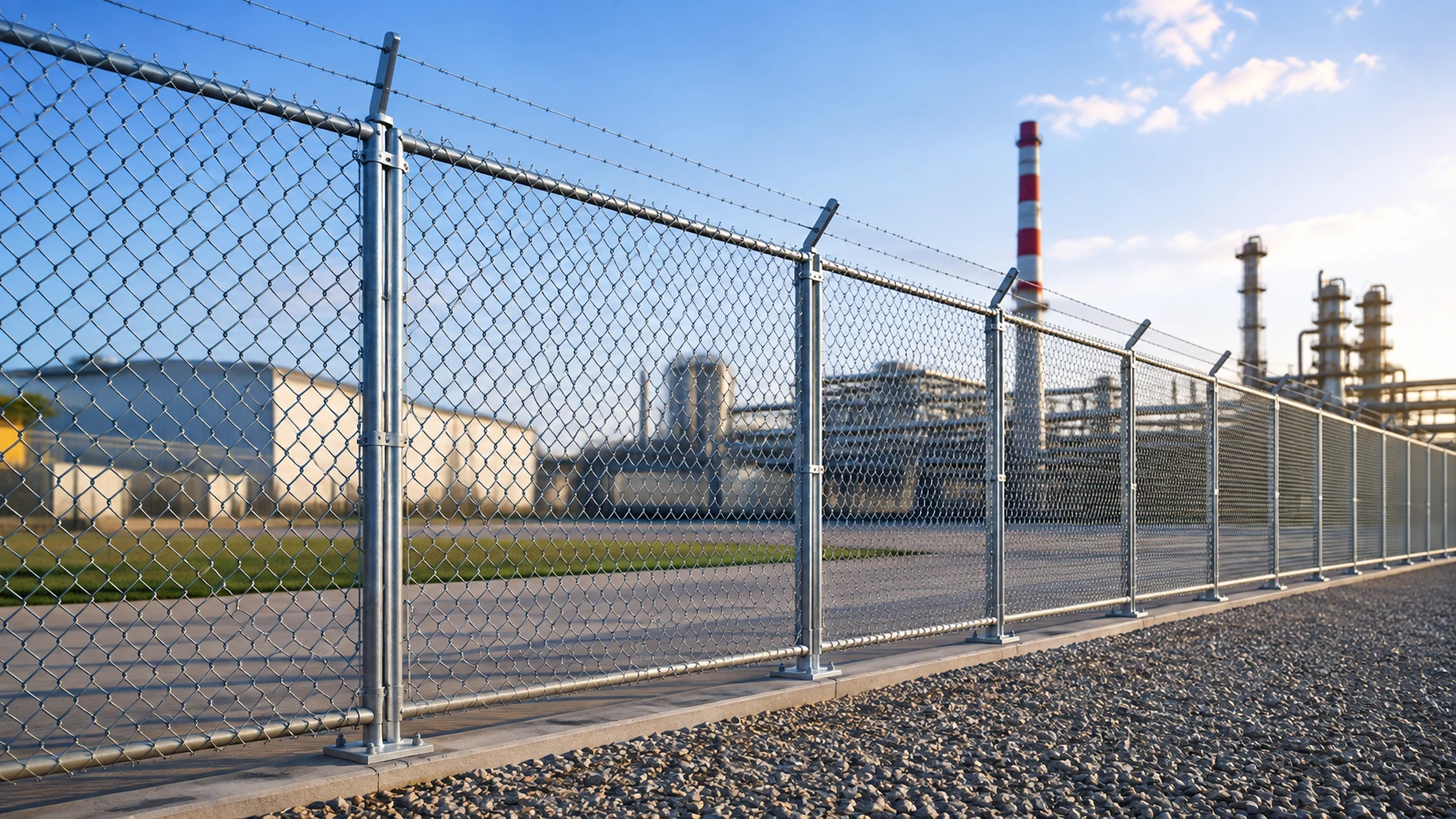

It is entirely possible that two projects involving fence construction need the same boundary distance but will have entirely different specifications in terms of barbed wire requirements.
Whereas a farm fence does not experience similar exposure to a coastal industrial establishment, consumers make comparisons based on the cost of the reels without regard for diameter, coating, or expected lifespan.
This strategy could turn out to be costly.
Selecting the right barbed wire fencing involves understanding where it will be installed, what level of protection is required, and how long the installation must perform.
For contractors and procurement teams, getting these specifications right at the purchasing stage can prevent premature corrosion, unnecessary maintenance and material replacement.
Why Barbed Wire Remains a Critical Component of Perimeter Fencing
Barbed wire continues to be popular because of its use as a simple physical barrier without necessitating the construction of an entirely rigid barrier system.
The twisted wire comes with sharp barbs at regular intervals, thus making the passage difficult for those unauthorized. Provided it is put up using sufficient tension and support, the wire can be spread over a considerable distance and even adapt to varying terrains.
It is also quite easy to integrate into fence systems that already exist.
However, all barbed wire specifications do not serve the same purposes equally well.
Barbed Wire Types: Material, Performance and Applications
Choosing between barbed wire types is primarily a question of application. A temporary construction boundary and a permanent industrial perimeter should not automatically receive the same specification.
Stainless Steel Barbed Wire
For installations exposed to salt, moisture or aggressive industrial atmospheres, stainless steel barbed wire is worth considering.
Unlike coated mild steel, stainless steel derives its corrosion resistance from the alloy itself. This makes it relevant for coastal facilities, ports, chemical plants and other demanding environments.
The stainless steel grade still matters. Buyers should confirm its suitability for the specific exposure conditions rather than assuming all grades perform identically.
PVC Coated Barbed Wire
PVC-coated barbed wire combines galvanised steel wire with an additional polymer layer.
In addition to providing additional protection from environmental contamination, coating gives the surface a polished finish. This feature is especially beneficial for commercial buildings, institutions, residential areas, and boundary landscapes.
For procurement officers, quality of coating is important. Failure to adhere properly and damage while handling may affect its effectiveness
Fencing Barbed Wire
Not every application demands a specialised coating or material.
Fencing barbed wire provides a conventional physical deterrent for farms, livestock areas, rural properties and general boundary installations.
It is dependent on the wire structure, spacing between the barbs, post placement, and tension of installation.
Before placing an order, ensure that you have verified the diameter of the wire and its coating requirements.
MS Barbed Wire Fencing
Where the fencing requirement is temporary, initial material cost often carries greater weight.
MS barbed wire uses mild steel without a protective galvanised or polymer coating, making it a potential option for construction boundaries and short-term land demarcation.
The trade-off is corrosion resistance.
Unprotected mild steel deteriorates when exposed to moisture and atmospheric conditions. For permanent outdoor installations, its lower purchase price must be weighed against maintenance and replacement costs.
Galvanised Barbed Wire
For many outdoor fencing applications, galvanised barbed wire offers a practical balance between corrosion protection and cost.
A zinc coating protects the underlying steel, making this construction relevant for agricultural boundaries, warehouses, industrial premises and infrastructure projects.
But the presence of zinc alone does not tell the complete story.
Coating specifications, wire diameter and manufacturing quality influence long-term performance. Where applicable, buyers can refer to IS 278:2009 for galvanised steel barbed wire requirements.
How to Inspect Barbed Wire Material on Delivery
The materials need to be inspected before installation and not once problems arise.
First, check the fundamentals. Is the wire diameter the same as that ordered? Are the wires of the line twisted uniformly? Are the barbs fixed firmly and evenly spaced?
Second, check the surface.
Products made galvanized or PVC-coated must be inspected for any sign of damage, exposed sections, or mishandling. When coating specifications are given, ensure their confirmation by the test certificates and not just by visual appearance.
Additionally, inspect for reel labels, quantity, and standard compliance.
When working on large fencing projects, such inspections will help detect discrepancies early on.
What Controls the Barbed Wire Price in India?
A cheaper reel does not necessarily mean cheaper fencing.
When comparing barbed wire prices in India, consider the actual quantity and specification being supplied.
Wire diameter affects steel consumption. Barb spacing and construction determine how much material goes into each finished metre. Protective coatings add processing costs but may provide longer service life under the right conditions.
Even reel weights can be misleading when suppliers quote different lengths or constructions.
For meaningful comparisons, procurement teams should request quotations specifying:
- Wire diameter and material grade
- Coating type and specification
- Barb spacing and configuration
- Reel weight or length
- Applicable standards and delivery terms
Compare equivalent specifications and calculate the delivered cost against the actual quantity supplied.
For project-specific pricing, request a quotation from Satyam Buildtech based on your fencing requirements.
Get the Right Barbed Wire for Your Project
The right barbed wire is not necessarily the cheapest or the most corrosion-resistant option. It is the one that meets the site’s requirements without unnecessary cost.
A temporary construction boundary may justify MS barbed wire, while a coastal industrial installation could require stainless steel. For general outdoor applications, galvanised wire may provide the appropriate balance.
Satyam Buildtech manufactures MS, galvanised, PVC-coated and stainless steel barbed wire for agricultural, industrial, infrastructure and security fencing applications.
Share your project requirements, including wire diameter, coating, barb spacing and quantity, with the team.
Contact Satyam Buildtech to discuss the appropriate barbed wire specifications for your next fencing project.