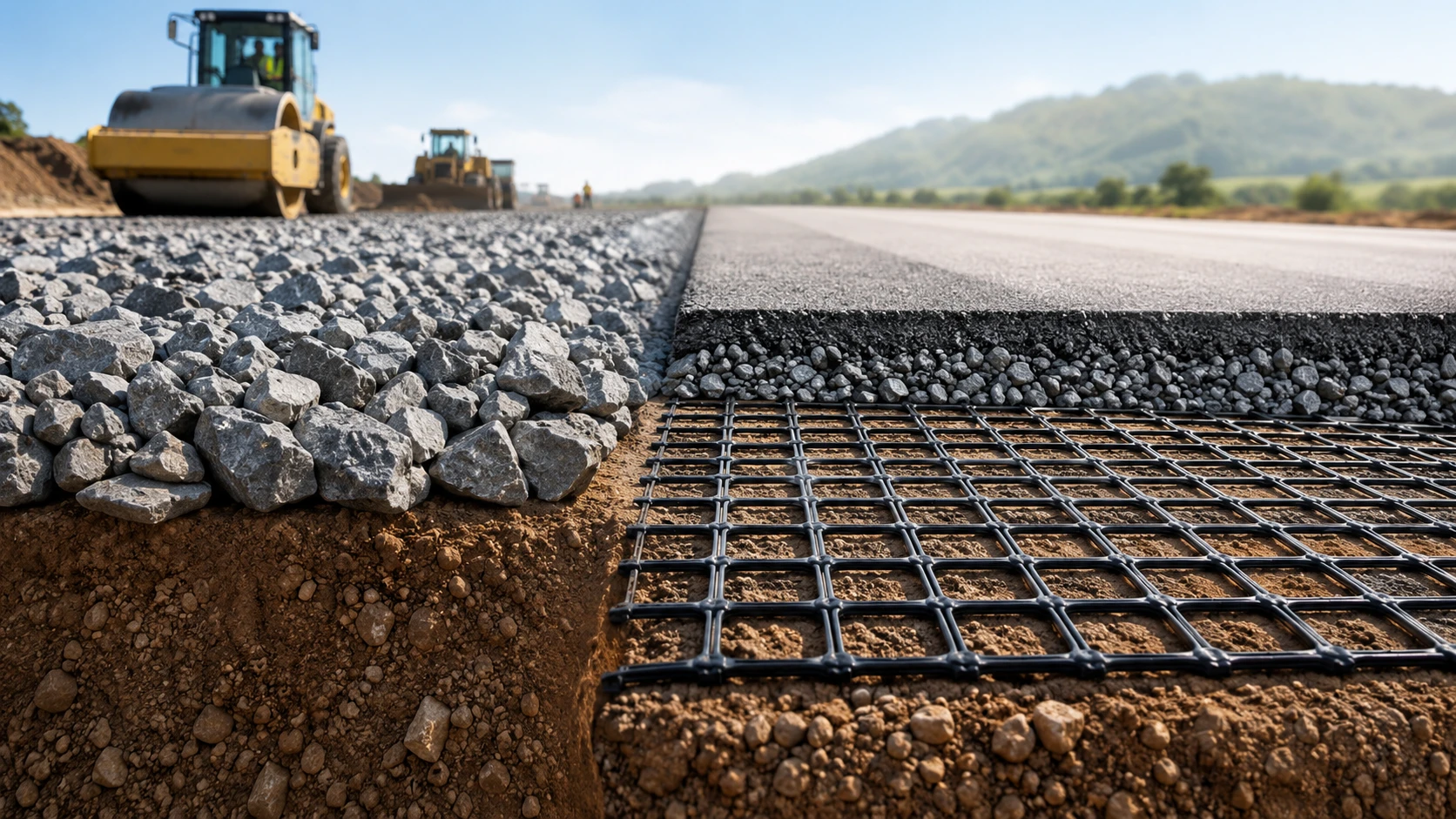
Road construction over weak or low-bearing subgrades creates a direct challenge for pavement performance. Under repeated wheel loads, weak soil can deform, allow aggregate movement, and contribute to rutting and uneven settlement. Increasing aggregate thickness alone is not always an efficient solution, particularly where the underlying soil has limited bearing capacity.
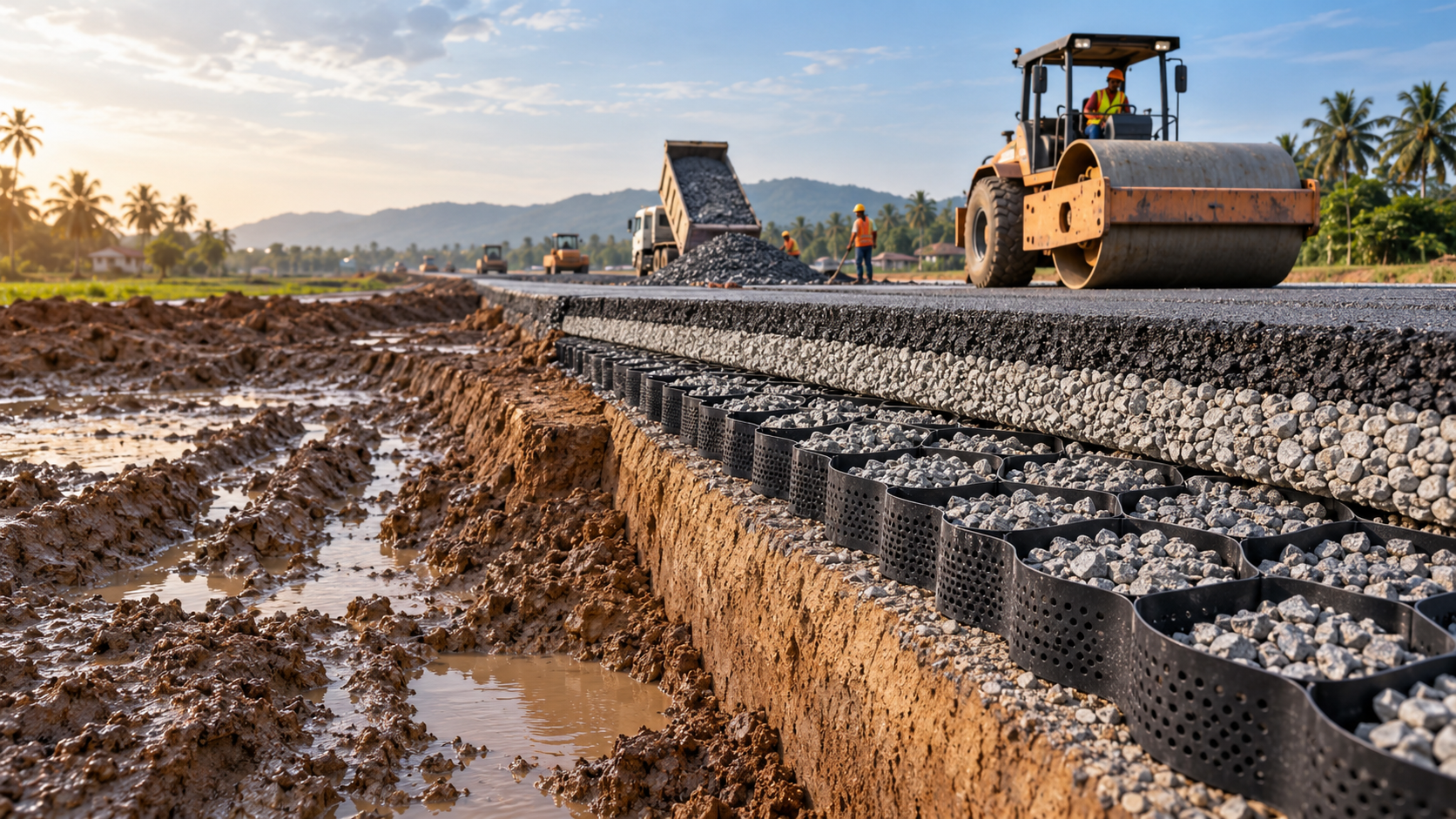
Geocell reinforcement addresses this problem by confining infill material within a three-dimensional cellular structure. The confinement restricts lateral movement of the infill and helps distribute applied loads over a wider area of the underlying subgrade.
This makes geocell for road construction suitable for subgrade stabilisation, subbase reinforcement and pavement ground improvement. The sections below explain the components of a geocell system, where geocell applications can provide load support, what to consider when choosing a system, and how it is installed.
Key Components of a Geocell System
For geocells in road construction, the effectiveness of this confinement depends on how the system is configured and how its individual elements work together. The key components that establish its cellular geometry and confinement structure include:
- Geocell panels: Interconnected polymer strips that form a three-dimensional honeycomb structure, creating individual cells for infill confinement.
- Welded joints: The joints connect adjacent strips and maintain the designed cell structure during expansion, filling, and service.
- Infill material: Aggregate or granular fill occupies the cells and forms the load-bearing medium. Its gradation, particle size, and compaction affect load transfer through the reinforced layer.
Beyond these components, cell height, cell size, weld spacing, and wall properties are important design parameters that influence the system’s confinement behaviour and suitability for specific ground conditions and loading requirements.
Satyam Buildtech manufactures geocell for pavement and ground improvement applications, with cell dimensions and material specified to suit different project requirements.
Where Does Geocell Provide Load Support?
Geocell reinforcement provides load support across varying traffic loads and ground conditions. Common applications include:
- Haul Roads: Heavy construction and mining vehicles impose repeated wheel loads on haul roads. Geocell confines the aggregate layer, helping limit lateral movement and maintain a stable running surface over weak subgrades.
- Rural Roads: Rural roads often pass through areas with variable or low-bearing-capacity soil. Geocell can be placed over the prepared subgrade to reinforce the road base, improve load distribution, and enhance stability on weak or variable ground.
- Parking Areas: Parking areas experience repeated vehicle loading across the pavement, with heavier loads in designated zones. Geocell can reinforce the base or subbase by confining the infill and improving load distribution into the underlying ground.
- Road Shoulders: Shoulders can experience deformation and aggregate movement when vehicles move toward the road edge. Geocell provides confinement within the shoulder layer, helping maintain its stability and profile under repeated loading.
- Access and Service Roads: Industrial and infrastructure sites often require stable access roads for regular vehicle movement. Geocell can be incorporated into the aggregate layer to improve confinement and load support where the underlying ground requires reinforcement.
For additional information on reinforcement applications, explore Satyam Buildtech’s pavement and ground improvement solutions.
What Factors Should You Consider When Choosing a Geocell System?
The geocell specification should be established after assessing the conditions under which the reinforced layer will be constructed and loaded. The main parameters to be evaluated are:
- Soil condition: CBR, soil type, moisture content, and the depth of the weak layer need to be established first. Soft clay, loose soil, and saturated ground may require different reinforcement arrangements.
- Traffic load: A road carrying heavy commercial vehicles places very different demands on the reinforced layer than a low-volume access road. Axle loads, traffic frequency and design life should be considered when determining the required load support.
- Cell dimensions: The selected cell height, size and weld spacing should correspond with the required reinforced-layer thickness, aggregate characteristics and expected loading conditions.
- Fill material: Aggregate should provide adequate interlock and compaction within the cells. Its grading, particle size and angularity need to be compatible with the selected cell geometry and pavement requirements.
- Material strength: Tensile strength, weld strength, stiffness, and resistance to environmental exposure become important when the system is expected to withstand heavy construction activity and long service periods.
- Site conditions: Drainage, groundwater, slope, access for installation, and construction sequence can influence the performance of geocell for road construction. These factors should be addressed before installation rather than after the pavement is completed.
Planning a road project on weak soil?
Share your soil data and traffic requirements with Satyam Buildtech, and our team will recommend a geocell specification suited to your site.
Request a Geocell Recommendation
How Is Geocell Installed for Road Construction?
The performance of a geocell-reinforced layer also depends on how the system is installed and integrated with the pavement structure. Installation begins with preparing and grading the subgrade to the required level, followed by placing any specified separation or drainage layer. The expanded geocell panels are then positioned and secured to maintain the designed layout during filling.
Once the panels are fixed, the selected aggregate or granular material is placed into the cells and compacted to achieve the required density. Filling and compaction need to be controlled to prevent panel displacement and maintain consistent confinement across the treated area. Proper geocell installation also requires attention to panel alignment, anchoring, and the construction sequence, particularly where the reinforced layer is being developed over variable ground conditions.
After the reinforced layer reaches the specified level and compaction, subsequent pavement layers can be constructed over it. This allows the geocell-reinforced layer to function as an integrated part of the pavement structure rather than as an isolated treatment.
Get Expert Guidance on Geocell Road Reinforcement
The right geocell configuration depends on the soil, traffic loading, and pavement design of each project. Satyam Buildtech manufactures geocell for road construction, pavement reinforcement, and ground improvement.