Every road engineer faces the same trade-off: soil conditions rarely match the design assumptions, but budgets and timelines don’t move to accommodate that gap. Weak subgrade soil traditionally meant one thing, more aggregate, thicker pavement layers, deeper excavation, and a higher bill. Biaxial geogrids offer an alternative that’s become standard practice on Indian road projects over the last decade: reinforce the soil instead of overbuilding around it.
What Are Biaxial Geogrids?
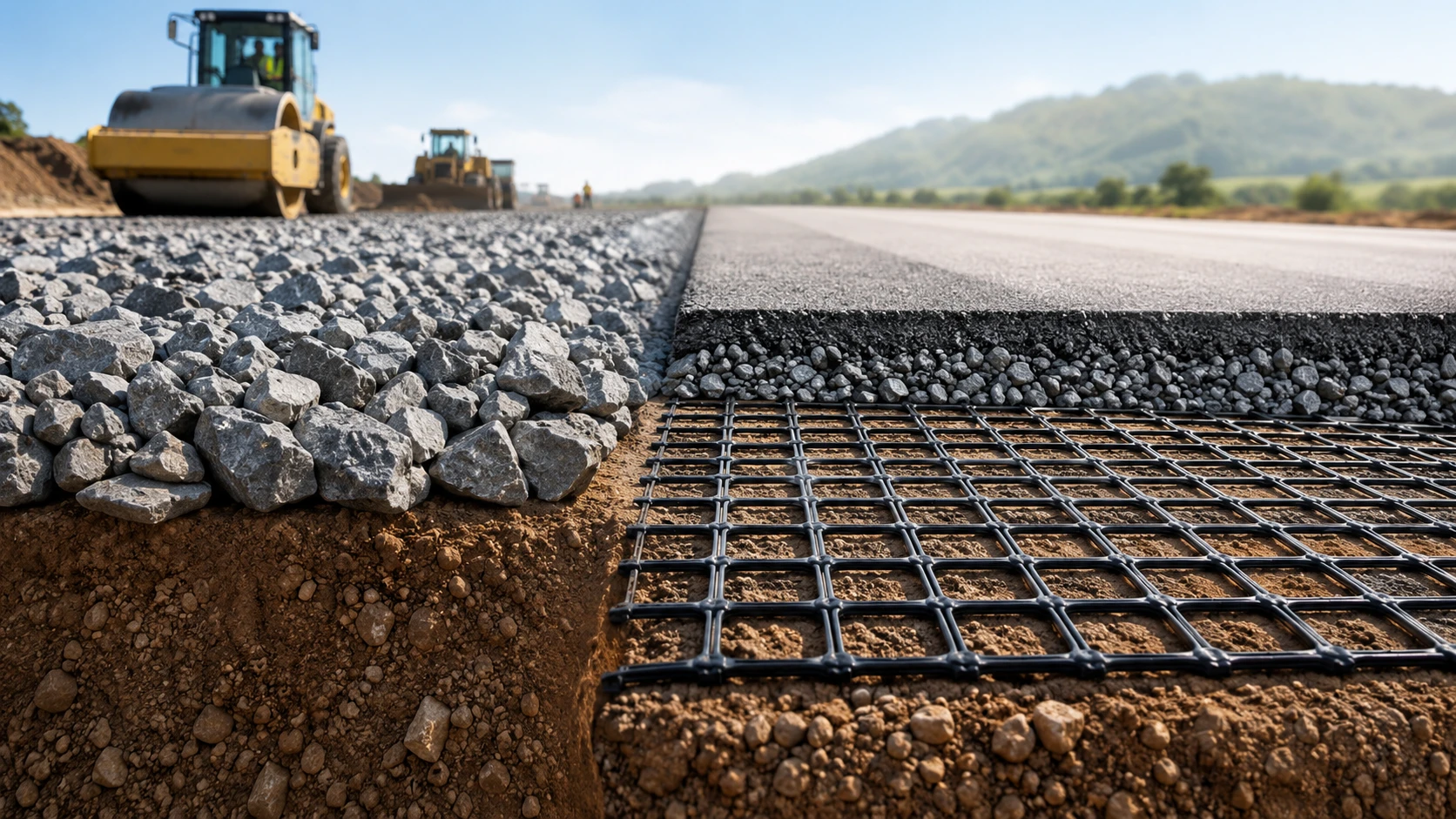
A biaxial geogrid is a grid-structured geosynthetic material, typically extruded and stretched in two perpendicular directions, that provides equal tensile strength along both axes. That “biaxial” property is what distinguishes it from uniaxial geogrids, which are stronger in one direction and better suited to retaining wall applications rather than pavement work.
When laid within or beneath a pavement structure, the grid interlocks with surrounding soil and aggregate particles. This interlock restrains lateral movement of the base material under traffic load, distributing stress over a wider area instead of concentrating it directly beneath the wheel path.
The Core Problem Geogrids Solve
Roads built on weak or variable subgrade soil, common across much of India’s expanding highway and rural road network, are prone to rutting, cracking, and premature failure. The conventional fix is to increase the thickness of the granular sub-base layer, which pushes up material cost, transport cost, and construction time, particularly on projects where quality aggregate has to be hauled in from a distance.
Biaxial geogrids address the same problem from a different angle: instead of adding more material to compensate for weak soil, they improve how the existing material performs.
How Biaxial Geogrids Improve Pavement Performance
Load Distribution
The interlock between geogrid and aggregate spreads traffic load over a larger area of subgrade, reducing the pressure concentrated at any single point. This is the primary mechanism behind reduced rutting and longer pavement life.
Reduced Aggregate Requirement
Because the grid improves the structural performance of the base layer, engineers can often reduce the thickness of the granular sub-base while still meeting design life requirements. On large projects, this translates directly into lower aggregate volume, fewer truck movements, and measurable cost savings.
Improved Long-Term Stability
Unreinforced granular layers are prone to lateral spreading under repeated traffic loading, a slow process that shows up as rutting and surface deformation over time. The geogrid’s interlock restrains this movement, helping the pavement structure hold its designed shape for longer.
Faster Construction on Soft Ground
On sites with soft or saturated subgrade, geogrids can reduce the need for extensive soil replacement or stabilization work, which shortens construction timelines, an important factor on projects with tight completion deadlines.
Where Biaxial Geogrids Are Used
- Highway and rural road construction — sub-base and base layer reinforcement
- Rail track beds — ballast stabilization under cyclic loading
- Airport pavements — high-load-bearing surface reinforcement
- Industrial yards and container terminals — heavy point-load areas
- Parking areas and access roads — cost-effective reinforcement for lighter-duty pavements
Discuss your project requirements?
Specification Factors That Matter
Aperture Size and Rib Structure
Geogrid performance depends on how well the aggregate interlocks with the grid apertures. Aperture size should be matched to the aggregate gradation used in the base layer; a mismatch reduces the interlock effect the geogrid is designed to provide.
Tensile Strength and Junction Integrity
Because biaxial geogrids rely on strength in both directions, junction integrity, how well the ribs are bonded at each intersection, is as important as the raw tensile strength of the ribs themselves. A geogrid with strong ribs but weak junctions will underperform under real traffic loading.
UV and Chemical Resistance
Geogrids installed close to the surface or exposed during construction need resistance to UV degradation before they’re covered. Material composition and stabilization additives affect how well the product holds up during the construction window.
Compliance with Design Standards
Indian road and highway projects increasingly reference IRC and MoRTH guidelines for geosynthetic reinforcement. Specifying geogrids with documented test data against these standards protects both project quality and procurement compliance.
Manufacturing Quality Is the Deciding Factor
Two geogrids can look identical on a spec sheet and perform very differently in the field. Extrusion consistency, rib thickness uniformity, and junction bonding are all determined during manufacturing, well before the product reaches a project site. Inconsistent production leads to localized weak points that can fail under concentrated load, even when the average tensile strength meets specification.
At Satyam Buildtech, biaxial geogrids are produced within our integrated manufacturing facility in Mehsana, with in-house testing before dispatch and material test certificates provided for every batch. That means engineers specifying our geogrids are working with documented, traceable performance data, not assumed compliance.
Building Smarter, Not Just Thicker
Biaxial geogrids won’t replace sound engineering judgment, but they give road builders a genuine alternative to over-engineering pavement structures around weak subgrade soil. For projects balancing cost, timeline, and long-term durability, that alternative is increasingly the standard choice.